
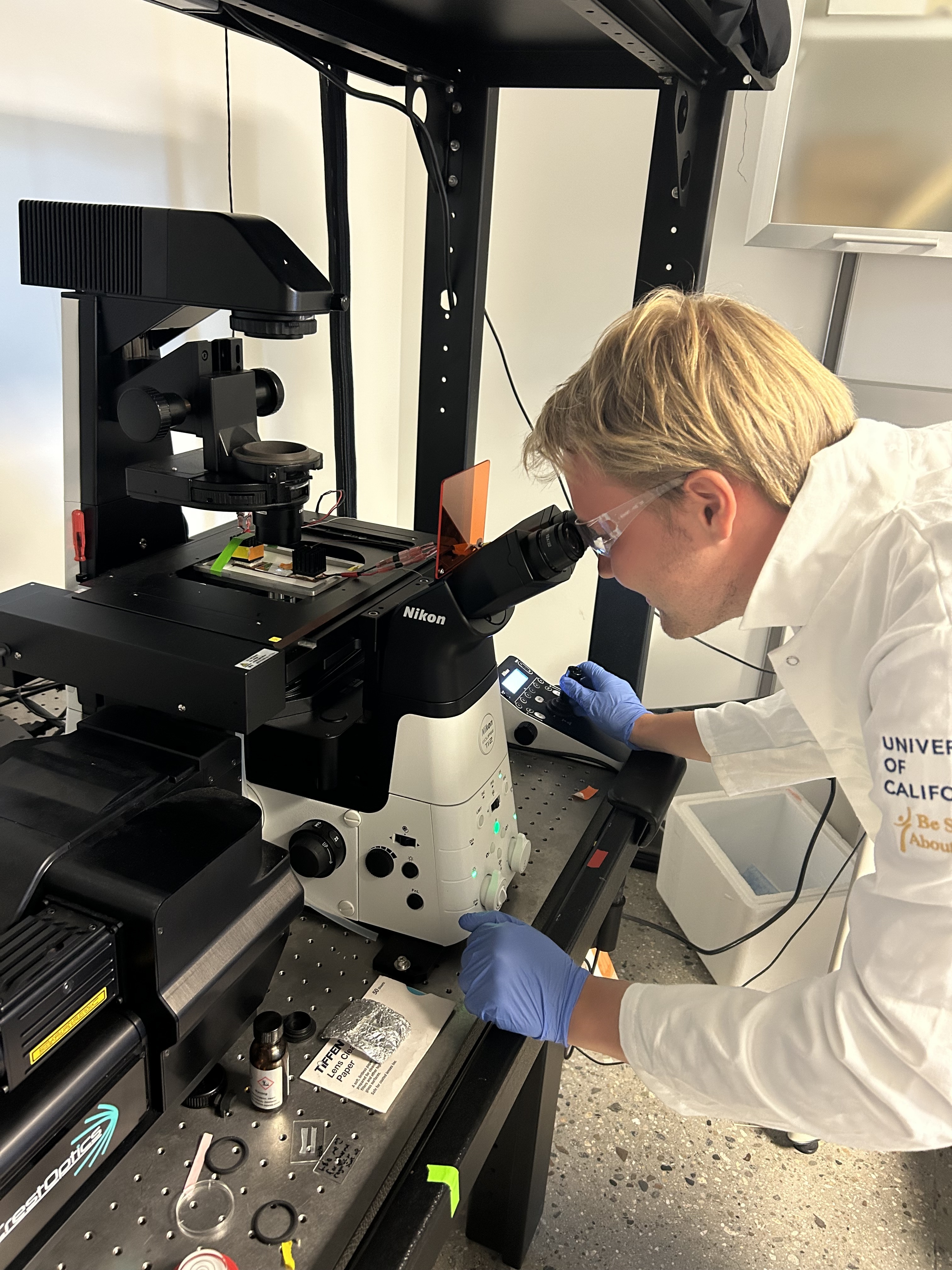
Biomolecules can form dense condensate droplets while undergoing liquid-liquid phase separation. This plays key roles in cellular organization and behavior. These droplets are relevant for applications such as nano-medicine and synthetic biological systems. Phase-separating DNA nanostar particles can serve as a model system to study the mechanisms underlying these phase separations. These nanoscale particles possess four arms with terminal ssDNA palindromic sticky ends that can hybridize with other sticky ends, forming dense networks and driving phase separation. Photocleavable spacers, a structural modification of the DNA strands that make up the nanostar particle, can be incorporated into the nanostar design. Upon UV irradiation, the spacer cleaves the nanostar in half, removing its ability to phase separate and resulting in degradable droplets. When we irradiate a system containing both modified and unmodified DNA nanostars, we observe only the photosensitive droplets degrading. By introducing additional cross-linker nanostars to alter the wettability between previously distinct phases, we can create a droplet-in-droplet structure. The phase containing photodegradable nanostars can be steered to form the inside droplet by reducing their arm length and increasing their sticky-end binding strength. This allows us to selectively photodegrade the inner phase, while leaving the outer phase intact. Overall, this project advances understanding of complex structural condensate design and the degradation mechanisms of such architectures, providing new insights into compartment formation in artificial cell systems.